

What we do
Deepen our knowledge of living biological matter
We aim to elucidate the laws of physics that underlie the dynamic spatiotemporal organization of life into molecules, cells and tissues. Our focus is to bring fundamental physics to biology for the purpose of understanding and solving biological questions.
Our research is enabled by merging theory and experiment and driven by a collaborative atmosphere in Geneva between University and partner research laboratories.
Our approach: vision & mission
We seek to understand living matter as a self-organizing and active form of soft condensed matter — combining quantitative experiments with theory to explain how biological order emerges, is maintained, and adapts — from single molecules to whole organisms.
Groups
Gonzalez-Gaitan Lab — Biophysics and Cell Biology of Signaling
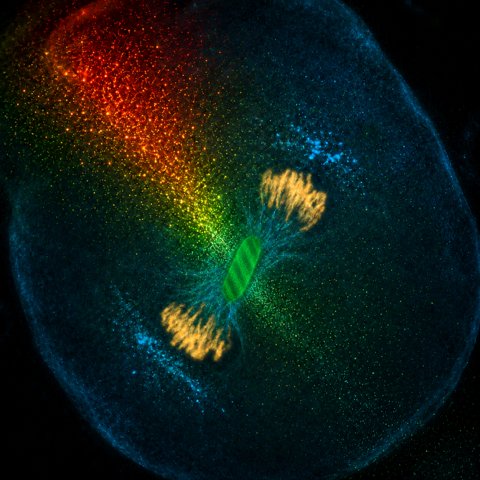
We want to understand in physical and molecular terms how cells talk to each other during development. This means our research is highly interdisciplinary: physics, cell biology, molecular biology, biochemistry, genetics... Indeed some of us in the lab are biologists, other physicists, chemists, engineers or mathematicians.
Kruse Group — Organization of cells and tissues
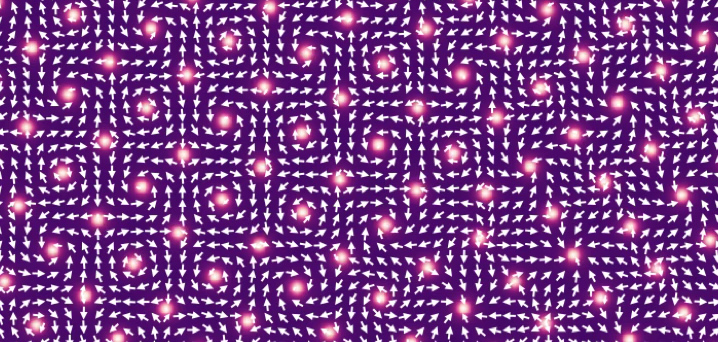
Our aim is to understand collective phenomena in living cells and tissues. To this end we use methods and concepts from theoretical physics and nonlinear dynamics to study specific systems preferentially in collaboration with experimental colleagues. From the point of view of physics, a major challenge lies in treating systems out of thermodynamic equilibrium that play a role in the context of vital biological processes and have an evolutionary history. The description and analysis of these different aspects requires the development of new tools and approaches.
Martin Lab — Cell polarity and fusion
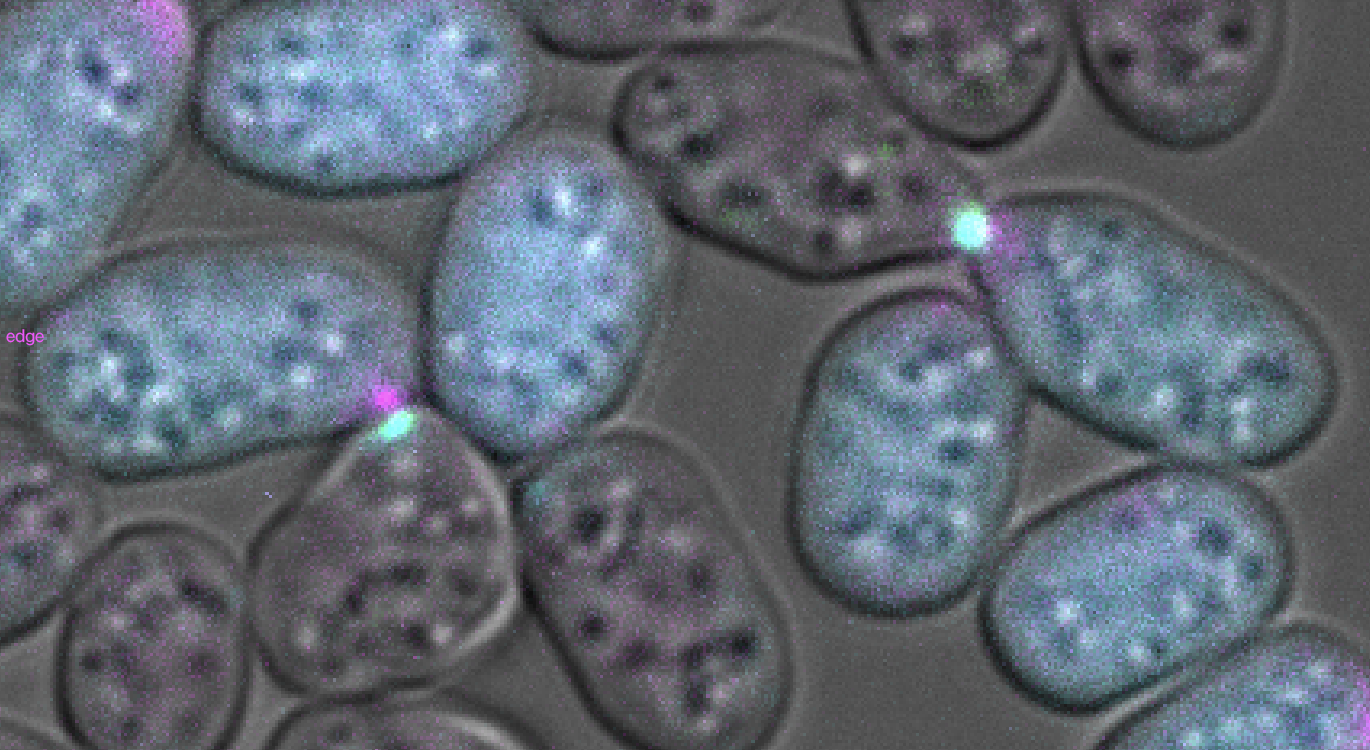
The Martin lab studies the processes of cell polarization and cell-cell fusion, with a particular interest in actin cytoskeleton and membranes. We use a combination of quantitative advanced live and super-resolution imaging for quantitative measurements, as well as genetic and biochemical tools in yeast. A current focus is to understand mechanisms of actin aster formation for vesicle clustering and plasma membrane fusion during cell-cell fusion.
Publications
2026
- Egoldt C, Velluz MC, Tran J, Aumeier C, Microtubule lattice conformation and integrity regulate α-tubulin acetylation, Communications Biology (2026).
- Multian V, Bonacina L, Teyssier J, Single acquisition reconstruction of nonlinear susceptibility and Raman tensors at the diffraction limit, APL Photonics 11, 6 (2026).
- Elsner CM, Hanke AA, Vadas O, Gervasio FL, Bordignon E, Structural and dynamic basis of indirect apoptosis inhibition by Bcl-xL: A case study with Bid, Proceedings of the National Academy of Sciences of the United States of America 123, 20 (2026).
- Dumolard S, Multian V, Gheata A, Spada A, Pierzchala K, Lanz B, Dhouib A, Mugnier Y, Teyssier J, Bonacina L, Chauvin AS, Gerber-Lemaire S, Click Chemistry Functionalization of Harmonic Nanoparticles with Lanthanide Complexes Towards Tunable Platforms for Multimodal Imaging, Nanomaterials 16, 591 (2026).
- Hakala M, Moparthi SB, Ganeva I, Gül M, Bernat C, Marcuello C, Espadas J, Colom Diego A, Kudryashev M, Kukulski W, Vassilopoulos S, Kaksonen M, Roux A, Two-dimensional HRS condensates drive the assembly of flat clathrin lattices on endosomes, Nature Communications 17, 6336 (2026).
- Melero A, Basante Bedoya MA, Muriel Lopez O, Martin S, Arp2/3-dependent actin assembly shapes endosomes and promotes intracellular trafficking in fission yeast, Current Biology 36, 1857 (2026).
- Zelic M, Gligorovski V, Labbaf F, Labagnara M, Oesterle R, Brenna G, Massard F, Chethan SG, Li W, Martin S, Hauf S, Rahi SJ, Love-thy-neighbor: Neural networks for tracking and lineage tracing in budding yeast, Bioinformatics Advances 6, vbag067 (2026).
- González Sanchis N, Bayard F, García-Arcos JM, Mandal T, Roux A, Sakai N, Matile S, Flipper dendrimers, Chemical Science 17, 7509 (2026).
- Barbosa N, Gendreizig D, Brazard J, Kucher S, Bordignon E, Adachi T, Construction of Complete Phase Diagrams for Protein Liquid–Liquid Phase Separation by In Situ Raman Microspectroscopy, The Journal of Physical Chemistry Letters 17, 2447 (2026).
- Thomas V, Mase H, Michon L, Picco A, Kaksonen M, Martin S, High-resolution mapping of the actin fusion focus reveals myosin V–dependent formin transport for aster formation, The Journal of Cell Biology 225, e202510018 (2026).
- Elsner CM, Epasto L, Cieren A, Gendreizig D, Kucher S, Roderer D, Bordignon E, Characterization of the Direct and Indirect Inhibition of Apoptosis by Full‐Length Recombinant Bcl‐xL Monomers, ChemBioChem 27, e202500683 (2026).
- Martin S, Cellularization: Compartmentalizing a sphere deep into its center, Current Biology 36, R54 (2026).
- Mandal T, Roux A, Garcia Arcos JM, Fluorescence lifetime estimation: A practical approach using Flipper-TR FLIM, Methods in Enzymology 27, 179 (2026).
- Kim D, Latshaw AL, Balkota M, Wiggert M, Alata M, Huang S, Constant S, Maechler P, Vanden Berghe P, Bonacina L, Third harmonic generation microscopy reveals structure and mucus dynamics in human airway epithelium models, iScience 29, 10 (2026).